How to Start Running Again After Years Off: The Dad’s Guide
You used to run. Maybe you did it at school, in your twenties, before the kids. Now the idea of going for a jog fills you with a mix of nostalgia and dread because you know — you know — it’s going to be a lot harder than you remember.
Good news: it comes back faster than you think. Bad news: most dads who try to start running again do it wrong and end up injured or miserable by week two. Here’s how to do it properly.
The Biggest Mistake Returning Runners Make
Going too fast, too soon. Your cardiovascular fitness will return relatively quickly — your lungs and heart adapt faster than your tendons, ligaments, and joints. The result: you feel like you can push harder than your body can actually handle, and you get injured.
The rule: if you can’t hold a conversation while running, you’re going too fast. This feels embarrassingly slow at first. Do it anyway.
The 8-Week Return to Running Plan
Weeks 1–2: Walk/Run Intervals
3 sessions per week. Start with a 5 minute brisk walk to warm up, then:
- Run 1 minute, walk 2 minutes
- Repeat 6–8 times
- Cool down walk 5 minutes
Total time: 25–30 minutes. The running will feel easy — that’s the point. You’re conditioning your joints, not your lungs.
Weeks 3–4: Building the Run Intervals
- Run 2 minutes, walk 1 minute
- Repeat 6–8 times
- Total running time: 12–16 minutes per session
Weeks 5–6: Continuous Running
- Run 15–20 minutes continuously at conversational pace
- 3 sessions per week
- One session slightly longer (20–25 minutes) at the weekend
Weeks 7–8: Building Distance
- Two runs of 20–25 minutes during the week
- One longer run of 30–35 minutes at the weekend
- By end of week 8 you should be able to run 5K comfortably
Kit Worth Buying
Running Shoes — The Only Non-Negotiable
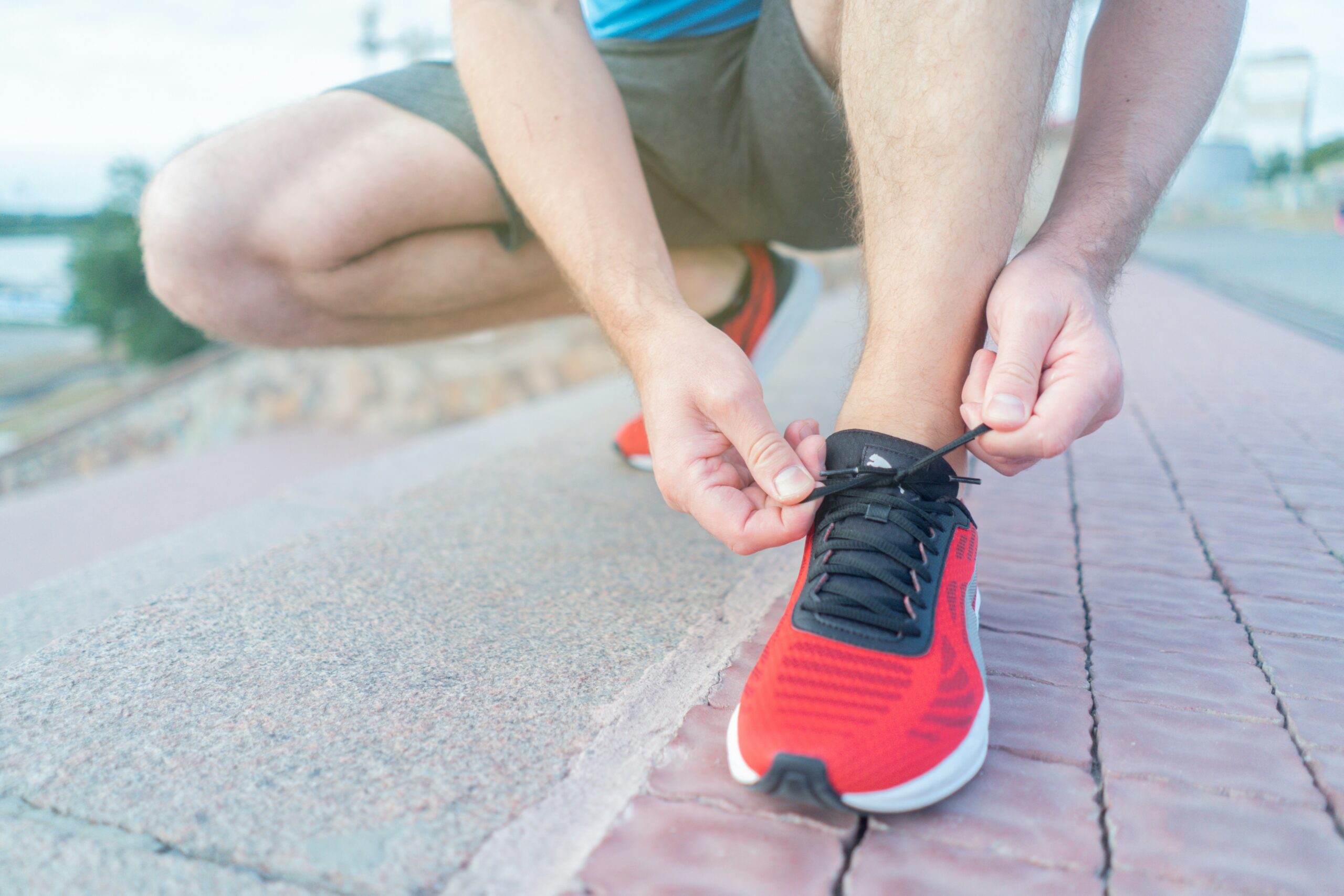
Don’t run in old trainers. Running shoes have cushioning and support designed specifically for the repetitive impact of running. Using old cross-trainers or gym shoes is a fast track to knee and shin problems.
You don’t need to spend £150. Brooks Ghost, ASICS Gel-Nimbus, and New Balance Fresh Foam all have models in the £80–100 range that are excellent for returning runners. Buy from a running shop where staff can watch you walk and advise on pronation — or use Amazon’s returns policy to try a couple of pairs.
A Fitness Tracker — Useful but Not Essential
A basic fitness tracker or smartwatch lets you monitor pace, heart rate, and distance. Keeping the data makes it easier to track progress and stop yourself going too fast. Garmin, Fitbit, and Apple Watch all work well. A cheap Fitbit Inspire is fine to start — you don’t need a GPS watch until you’re running regularly.
Common Problems and How to Avoid Them
Shin Splints
Pain along the inner shin, usually worse during or after runs. Almost always caused by doing too much too soon. Solution: reduce volume, run on softer surfaces, check your shoes, and build up more gradually.
Knee Pain
Runner’s knee (pain around the kneecap) is common in returning runners. Often related to weak glutes — add single-leg exercises to your strength training. If it persists beyond a couple of weeks, see a physio.
Side Stitches
The sharp pain in your side that shows up when you’re unfit and going too fast. Don’t eat 2 hours before running, slow down, and focus on exhaling fully. They disappear as your fitness improves.
How to Actually Stick to It
- Schedule it like a meeting — put it in your calendar. “I’ll run when I have time” means you won’t run
- Run with someone — a mate, your partner, a running club. Social accountability is highly effective
- Use Parkrun — free, every Saturday morning, friendly for all paces. Find your local one at parkrun.org.uk. Walking is fine
- Track your progress — Strava is free and seeing improvement week on week is motivating. A Garmin Forerunner pairs brilliantly with Strava
- Don’t skip two in a row — the classic rule. Miss one, fine. Miss two and the habit is breaking down
The Goal: Parkrun by Week 8
Give yourself a target. If you follow this plan, you should be able to complete a 5K Parkrun by the end of week 8 — even if you need to walk some of it. Sign up at parkrun.org.uk (it’s free), download your barcode, and turn up on a Saturday morning. The atmosphere is genuinely encouraging for all abilities.
Also useful: Best fitness tracker for dads UK — to track your runs and monitor your progress.